 USD


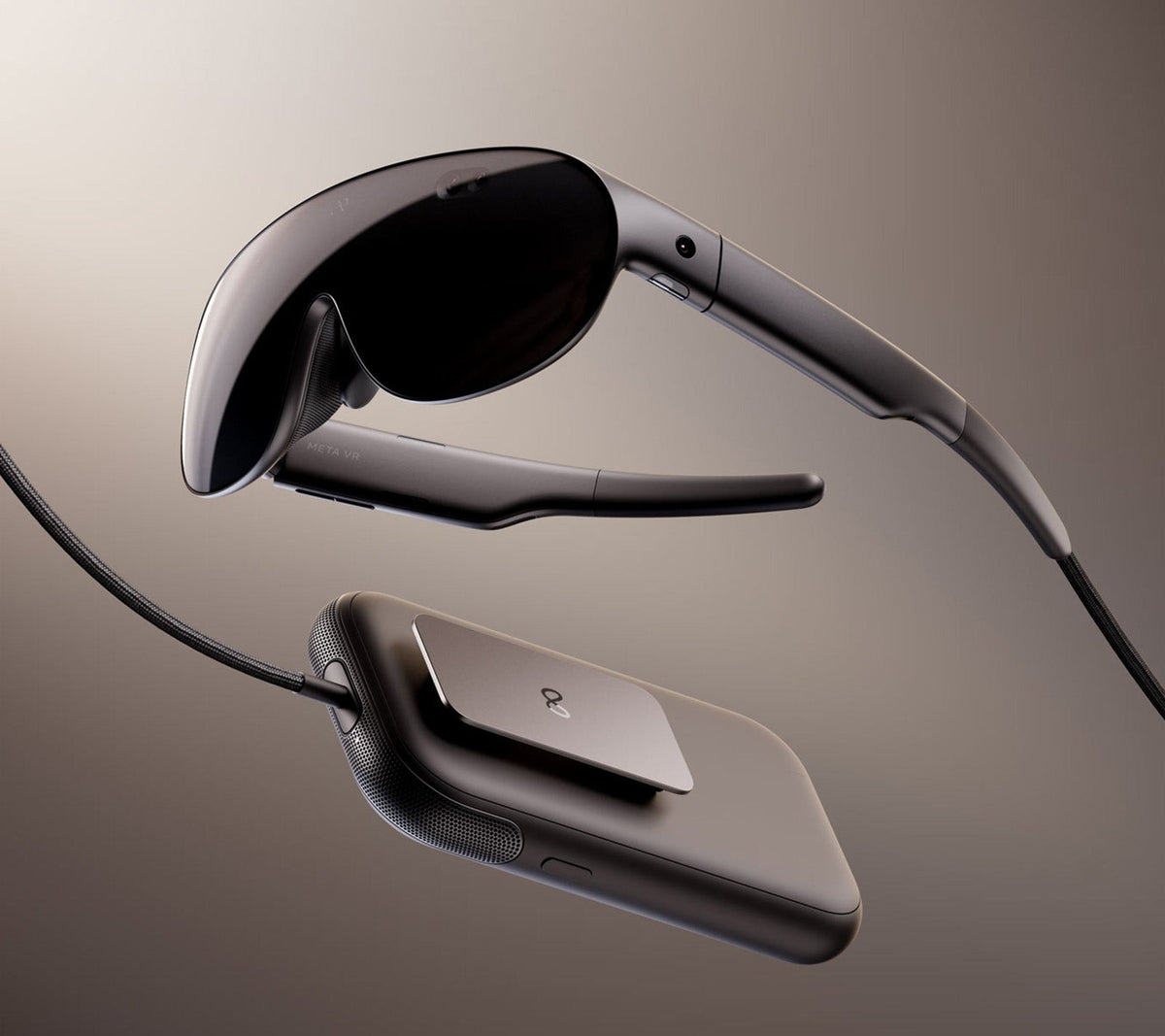
Meta’s hardware roadmap has officially taken its most radical pivot yet. While company representatives insist that the Quest line is not dead, the spotlight has decisively shifted to a sleek, $1,300 tethered headset referred to internally and externally as Meta’s "VR Glasses" (formerly Project Phoenix).
Targeting a release in the first half of 2027, this lightweight, compute-puck-driven device is built on the same underlying OS as Quest 3, features hand-tracking-first controls, and supports Touch Plus controllers. Yet Meta explicitly refuses to label it Quest Air, Quest 4, or Quest Pro 2. Instead, Ryan Cairns, Meta’s VP of VR, described it as part of an expanding "glasses continuum" stretching from smart audio frames all the way to full immersion.
Behind the slick industrial design lies a stark reality: Meta is retreating from its multi-billion-dollar VR gaming spree. In its place emerges an ecosystem built around productivity, spatial communication, lightweight ergonomics, and wearable AI.

The Quiet Demotion of Quest
The pivot toward lightweight eyewear explains a devastating sequence of decisions across Reality Labs over the past year:
-
Internal Studio Shutdowns: Meta shuttered core first-party game development teams, including Armature Studio (Resident Evil 4 VR), Twisted Pixel (Deadpool VR), and Sanzaru Games (Asgard’s Wrath).
-
Canceled Flagship Projects: Third-party funding faucets were abruptly turned off, impacting major initiatives from Skydance Interactive (Harry Potter), Cloudhead Games, and Polyarc (Moss).
-
Industry-Wide Ripple Effects: Respected XR stalwarts like Schell Games and Mighty Coconut were forced to downsize or reorient away from pure standalone VR headsets as the gaming market cooled.
-
The "Metaverse" Uncoupling: Horizon Workrooms has been wound down, and Horizon Worlds has been severed from its Quest exclusivity to become a broader cross-platform 2D social experience.
As Meta CTO Andrew Bosworth bluntly summarized, "the good times are over" for unrestrained gaming subsidies. You do not gut a specialized games ecosystem if you plan to launch a traditional, console-style gaming headset in the immediate future.
From Heavy Face-Bricks to the Glasses Continuum
Why the drastic shift? Meta realizes the bulky plastic box strapped to the face is a dead end for mainstream consumer adoption.
By offloading the heavy processing silicon and the bulky battery cells onto an external tethered puck, Meta shaved the headset visor down to roughly 110 grams. It mimics the form factor Apple attempted with Vision Pro, but refines it into something closer to thick eyewear.
More importantly, it serves as the ideological and behavioral bridge to true augmented reality—acting as a commercial stepping stone toward Orion-style AR glasses.
The message is unmistakable: the future of spatial computing belongs to eyewear, not helmets.
The Persistent Bottleneck: The External Power Imperative
While reducing facial weight by moving compute and battery cells to a tethered module is an engineering victory for head comfort, it highlights the fundamental rule of next-generation wearable hardware: all-day spatial computing cannot survive on miniature internal battery cells.
Whether you are wearing Meta's upcoming $1,300 mixed reality frames with an external puck, or wearing Ray-Ban Meta glasses throughout your workday, cameras, microphone arrays, dynamic sensors, and AI agents demand continuous energy. Users do not want to take their eyewear off every few hours just to recharge in a bulky case.
To achieve continuous ambient capture and lifecoding without interrupting your day, external power architecture is no longer optional—it is mandatory.

What Happens to Quest Now?
Quest is not being killed off overnight. With a massive installed base and a mature catalog of titles, Quest 3 and Quest 3S will continue to serve as relatively affordable, accessible gaming entry points.
However, Quest has been strategically demoted. It is no longer the flagship North Star of Meta’s spatial ambitions. The future is lighter, smarter, and sits squarely on your nose bridge—and keeping those smart frames powered from morning to night will be the defining challenge of the spatial era.