 USD
USD


For years, the gaming headset reigned supreme as the default audio solution for serious players. Their large drivers and prominent microphones became a familiar sight. However, a quiet revolution is underway. A new category of audio gear is challenging the status quo, offering a blend of portability, performance, and comfort that traditional headsets struggle to match. We are talking about specialized earbuds for gaming. But not all earbuds are created equal for this demanding task. The journey to find truly good gaming earbuds begins with understanding one critical, non-negotiable feature: latency.
Latency, the delay between an action on-screen and the corresponding sound in your ears, is the arch-nemesis of competitive and immersive gaming. A split-second lag can mean the difference between a perfect parry and a devastating hit, between pinpointing an enemy's footsteps and being caught off guard. This is why the quest for the lowest latency earbuds for gaming is more than a niche pursuit; it's essential for any gamer looking to leverage every possible advantage. For a deeper dive into this crucial technology, explore our dedicated resource on lowest latency wireless earbuds.
This guide will dissect the anatomy of premium gaming earbuds, moving beyond marketing claims to the core technologies that matter. We will explore why certain features are indispensable, how they enhance your gameplay, and ultimately, recommend a product that embodies these principles.
What Truly Defines Good Gaming Earbuds?
Gaming earbuds must excel in three fundamental areas where standard consumer earbuds often fall short: audio synchronization, sound quality tailored for games, and seamless multi-platform connectivity.
Why Is Ultra-Low Latency the Most Important Feature?
Latency below 40ms is generally considered acceptable for gaming, but for competitive play, aiming for 30ms or lower is ideal to achieve perceptual synchronization.
The human brain is remarkably sensitive to audio-visual desynchronization. Studies suggest that delays as low as 50 milliseconds can become noticeable and disruptive, breaking immersion and hindering reaction times. Standard Bluetooth earbuds, even with modern codecs like aptX Adaptive, can introduce latency ranging from 60ms to over 150ms. This is fine for listening to music but catastrophic for gaming.
True gaming earbuds solve this with proprietary, optimized wireless technologies, often involving a dedicated USB dongle. This dongle creates a direct, high-bandwidth connection between your device and the earbuds, bypassing the slower, more complex Bluetooth handshake protocols. The result is latency that can plummet to 25ms or even lower, ensuring that the crack of a sniper rifle, the reload of a weapon, or the subtle rustle of grass happens in perfect lockstep with the visual cue.
How Does Sound Design Differ From Music Listening?
Gaming audio requires a wide soundstage for spatial awareness and detailed frequency response to distinguish critical sound effects, prioritizing clarity and positioning over overwhelming bass.
While music listening earbuds might emphasize a powerful, bass-heavy signature, gaming demands precision. A good gaming audio profile provides a wide and accurate soundstage, allowing you to perceive whether an enemy is approaching from your left, right, or behind. It also requires clear differentiation across frequencies: the high-frequency ting of a spent shell casing hitting the floor, the mid-range crunch of footsteps on gravel, and the low, resonant boom of an explosion must all be distinct and localized.
This is achieved through careful driver design and expert audio tuning. Components like high-purity copper coils and rare earth magnets contribute to a driver's ability to respond quickly and accurately to the complex audio signals games produce, delivering both the impactful depth for immersion and the crystalline clarity for tactical advantage.
Can One Pair of Earbuds Work on All My Devices?
Versatility is key; the best gaming earbuds should offer plug-and-play compatibility with PCs, consoles, VR headsets, and mobile devices without requiring complex drivers or setup.
The modern gamer is rarely platform-exclusive. You might play a competitive shooter on PC, explore a sprawling RPG on a console, and enjoy mobile games or cloud streaming on a phone or tablet. A dedicated gaming headset often ties you to a single device or requires cumbersome adapters.
Advanced gaming earbuds solve this through universal dongles. A single, compact USB-C (or USB-A with an adapter) dongle should be recognized instantly by Windows, macOS, PlayStation, Nintendo Switch, Android devices, and popular VR headsets like the Meta Quest 3. This eliminates the friction of switching gear and ensures your preferred audio experience is always available, regardless of what you're playing.
Introducing the Vega T1: A Case Study in Modern Gaming Audio
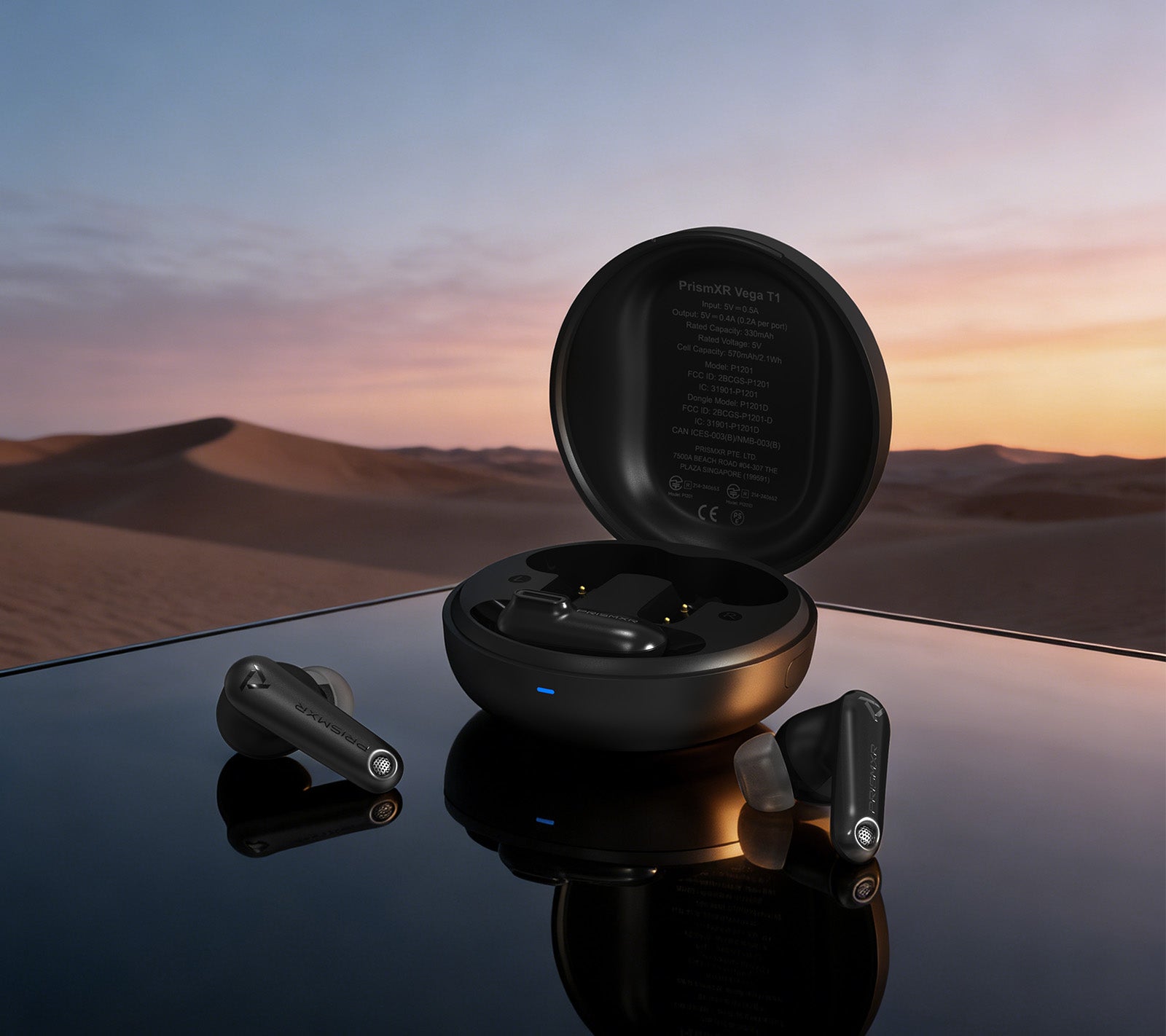
Having established the critical criteria, let's examine a product that integrates these principles into a single, cohesive package: the PrismXR Vega T1 Low Latency Wireless Earbuds.
What Makes the Vega T1's Audio Experience Exceptional?
The foundation of the Vega T1's sound is its custom-designed 10mm dynamic driver. It utilizes a composite diaphragm made from PU and bionic fiber layers, which is both lightweight for responsiveness and rigid for control. This is paired with a high-purity copper coil and powerful rare earth magnets. This hardware combination is engineered to minimize distortion and deliver a dynamic range that captures everything from the subtle ambient sounds of a game world to the intense, explosive moments of action. PrismXR's proprietary audio tuning further refines this hardware potential, resulting in clear, high-fidelity sound that enhances both your gaming immersion and everyday listening experience.
How Does ZeroDrag Tech Achieve Such Low Latency?
The Vega T1's standout feature is its proprietary ZeroDrag Technology. This system is engineered to slash end-to-end latency to an industry-leading 25ms when using the included USB-C dongle. This figure is not just a marketing spec; it represents a level of synchronization where audio is perceptually instantaneous with on-screen action. Whether you are engaged in fast-paced VR gaming, reacting to visual cues in a competitive shooter, or simply watching a movie, the audio remains perfectly in sync, eliminating the distracting disconnect that plagues standard wireless audio.
How Does the Vega T1 Simplify a Multi-Device Setup?
The Vega T1 is designed with the platform-agnostic gamer in mind. Its universal dongle operates on a true plug-and-play basis. There are no drivers to install or complicated pairing modes to navigate. Simply insert the dongle into the USB-C port on your PC, laptop, Steam Deck, Meta Quest 3, PlayStation 5 (via front USB-C), Nintendo Switch (in docked mode), or Android phone, and the earbuds connect automatically. This seamless interoperability makes it an incredibly versatile tool for your entire digital ecosystem.
What Advanced Features Enhance the User Experience?
Beyond the core audio and latency performance, the Vega T1 incorporates thoughtful innovations that address common gamer frustrations.
- Super Passthrough Charging: The USB-C dongle features a pass-through charging port. This means you can connect the dongle to your device and simultaneously charge it at up to 27W speeds, without occupying your only USB-C port—a crucial feature for laptops, handheld PCs, and VR headsets.
- Play & Chat Simultaneously: This innovative feature allows you to receive game audio via the low-latency dongle connection while simultaneously connecting via Bluetooth to a smartphone for Discord, WhatsApp, or a phone call. You can communicate with your squad without any interruption to your game audio, a functionality rarely found in traditional wireless solutions.
- Customization via App: The companion PrismXR app unlocks full personalization. Users can create and save custom EQ profiles to tailor the sound signature for different game genres, adjust dongle settings, and install firmware updates to ensure the earbuds continue to improve over time.
For gamers seeking a unified, high-performance audio solution that transcends platform boundaries, the PrismXR Vega T1 Low Latency Wireless Earbuds present a compelling argument, embodying the key traits of truly good gaming earbuds.
Conclusion: The New Standard for Gaming Audio
The landscape of gaming audio is evolving. The bulk and isolation of traditional headsets, while still valuable for some, are no longer the only path to premium performance. Specialized earbuds for gaming have matured, offering a potent combination of convenience, comfort, and, most importantly, cutting-edge technical performance that directly translates to a better gaming experience.
The critical differentiator remains latency. Pursuing the lowest latency earbuds for gaming is not about chasing specs; it is about preserving the integrity of the interactive experience. When audio is perfectly synchronized, gameplay becomes more intuitive, immersive, and competitive. When combined with versatile connectivity, thoughtful features like pass-through charging and dual connectivity, and tunable, high-fidelity sound, the result is an audio tool that adapts to your lifestyle rather than constraining it.
As gaming continues to expand across VR, mobile, and cloud platforms, the demand for flexible, high-performance audio solutions will only grow. The technology demonstrated by products like the Vega T1 points toward a future where gamers no longer have to choose between performance and portability.
Frequently Asked Questions (FAQ)
Q1: Are low-latency gaming earbuds better than wired headphones?
A: In terms of pure, absolute latency, a high-quality wired connection is still technically unbeaten, as it involves virtually no signal processing delay. However, the gap has narrowed dramatically. Premium low-latency earbuds with dedicated dongles can achieve delays as low as 25ms, which is imperceptible to the vast majority of users and provides complete synchronization for gaming. The convenience, lack of cables, and advanced features like dual connectivity often make them a preferable and more versatile choice for many gamers.
Q2: Can I use gaming earbuds like the Vega T1 for music and calls?
A: Absolutely. While tuned for gaming, the high-fidelity drivers and support for standard Bluetooth codecs (like AAC and SBC) ensure they perform excellently for music streaming, podcasts, and voice calls. The built-in microphones are designed for clear voice capture, making them suitable for video conferences and everyday communication when not gaming.
Q3: How does the dual connectivity (dongle + Bluetooth) work, and what are the benefits?
A: The Vega T1 can maintain two active connections simultaneously: a ultra-low-latency connection via the USB dongle for your primary device (PC, console, VR), and a standard Bluetooth connection to a secondary device like your smartphone. The primary benefit is the "Play & Chat" function. You can hear game audio from your PC via the dongle while talking to friends on a Discord call through your phone's Bluetooth connection, all without any audio interruption or complex setup. It seamlessly merges two audio streams.